


Custom vinyl stickers on sheets are printed on Avery Dennison soft PVC vinyl and cut to any size and any shape. Vinyl is the material to choose when a sticker has to handle water, sunlight and daily handling.
We print with 9 color inks at high resolution for strong, accurate color, using Epson SureColor inks that are GREENGUARD certified.
Sizes, Options and Specifications
| Sizes | Any size |
|---|---|
| Shapes | Any shape |
| Material | Avery Dennison soft PVC vinyl |
| Printing | 9 color inks, high resolution |
| Ink | Epson SureColor, GREENGUARD certified |
| Production time | About 2 to 4 business days (vinyl needs drying time) |
| Files | AI (fonts outlined), PSD, JPG, PNG or PDF in CMYK. Rich black is C20 M0 Y0 K100. |
| Printed in | Chatsworth, California |
Where Vinyl Stickers Work Best
- Water bottles, tumblers and coolers
- Laptops, helmets and gear
- Car and window stickers
- Product labels and giveaways that need to last
Frequently Asked Questions
Are PVC vinyl stickers waterproof?
Yes. Vinyl stickers are waterproof and tear resistant, and they resist fading from sun and weather.
Can I order a custom shape?
Yes. We cut vinyl stickers to any size and any shape. Start from our free templates so the cut line, bleed and safe area are set correctly.
How long do vinyl stickers take?
About 2 to 4 business days, because vinyl prints need drying time. Production runs Monday to Friday, and shipping time is added after that.
When should I choose paper instead?
If the sticker stays indoors on packaging, boxes or mailers, glossy paper stickers on sheets cost noticeably less.
Design Templates That Make Every File Print-Ready
Download free design templates for all RedPrinting products. Each template includes the correct trim size, bleed, and safe margin, so your artwork prints exactly the way you designed it.
Sticker Templates
Individually cut stickers in every shape and size, plus multi-design sticker sheets.
Business Card Templates
Standard, mini, and square formats for every card design.
Flyer & Poster Templates
From handout flyers to large-format posters, print-ready at every size.
How to Use a Template
Four steps from download to a print-ready file.
Artwork Guidelines That Get
Every File Print-Ready
Every file submitted to RedPrinting is reviewed by a real person before it goes to press. This guide walks you through file formats, resolution, bleed, and cut lines, so your stickers, labels, and cards come out exactly the way you designed them.
We Print the File You Send
Design services are not offered. We print your artwork as supplied, optimized for press.
We print the file you upload. We don't redesign artwork, edit your text, or build print files from scratch, which is part of how we keep prices low and turnaround fast. What we do is prepare your file for the press: we check the size, bleed, and resolution, and make the technical adjustments needed for a clean print.
If a file cannot be printed as it is, we contact you by text, email, or both and ask for a corrected file. If we don't receive a print-ready file within 3 business days, we cancel the order and issue a full refund.
The Three Lines on Every Template
Understand these and your file will cut clean every time.

Accepted File Formats
Vector files give the sharpest results, but we accept high-resolution raster files too.
| Format | Type | Best For | Recommended |
|---|---|---|---|
| AI | Vector | Logos, text, line art, custom shapes | Best |
| Vector | Print-ready files with fonts outlined | Best | |
| EPS | Vector | Legacy vector artwork | Best |
| PSD | Raster | Layered photo-based designs | Good |
| PNG | Raster | Designs needing a transparent background | Good |
| JPG | Raster | Photographs and full-color images | Good |
| TIFF | Raster | High-quality scanned or photo artwork | Good |

- Outline your fonts: Convert all text to outlines or curves so typefaces render correctly on our end.
- Use CMYK color mode: Printing is a CMYK process. RGB files are converted automatically, and bright neon or vivid blues may shift slightly.
- Flatten transparency: Complex transparency and drop shadows can behave unpredictably; flatten them before exporting.
- Embed or attach linked images: Missing links are the most common reason a file gets sent back.
Image Resolution
300 DPI at final print size is the target.
Resolution is measured at the size the artwork will actually be printed. A 300 DPI image looks crisp on a 2-inch sticker but turns soft when stretched across a 24-inch poster. Always check the pixel dimensions against the finished size, not against how the file looks on screen.
Web images pulled from a website or social media are usually 72 DPI, which is roughly a quarter of the detail we need. Enlarging a low-resolution file doesn't add detail back. It only makes the softness more visible.
Low-resolution artwork? If your piece still reads clearly in print, we print it. If the text would be unreadable, we contact you and ask for a higher-resolution file.

Choosing Your Material
Where the sticker will live decides which stock to use.
- Waterproof and tear-resistant
- Resists fading from sun and weather
- Holds up on bottles, laptops, and cars
- Higher cost per sticker
- Thin, smooth, and easy to write on
- Noticeably lower cost per sticker
- Ideal for packaging, boxes, and mailers
- Not water- or weather-resistant
Clear stickers are printed on transparent vinyl, so the surface underneath becomes part of the design. They're waterproof, tear-resistant, and work beautifully on glass bottles, cups, laptops, and windows where a white sticker edge would look out of place.
Because there's no white backing, light colors and white ink behave differently than they do on paper. Designs with bold shapes, dark colors, or deliberate negative space tend to read best.
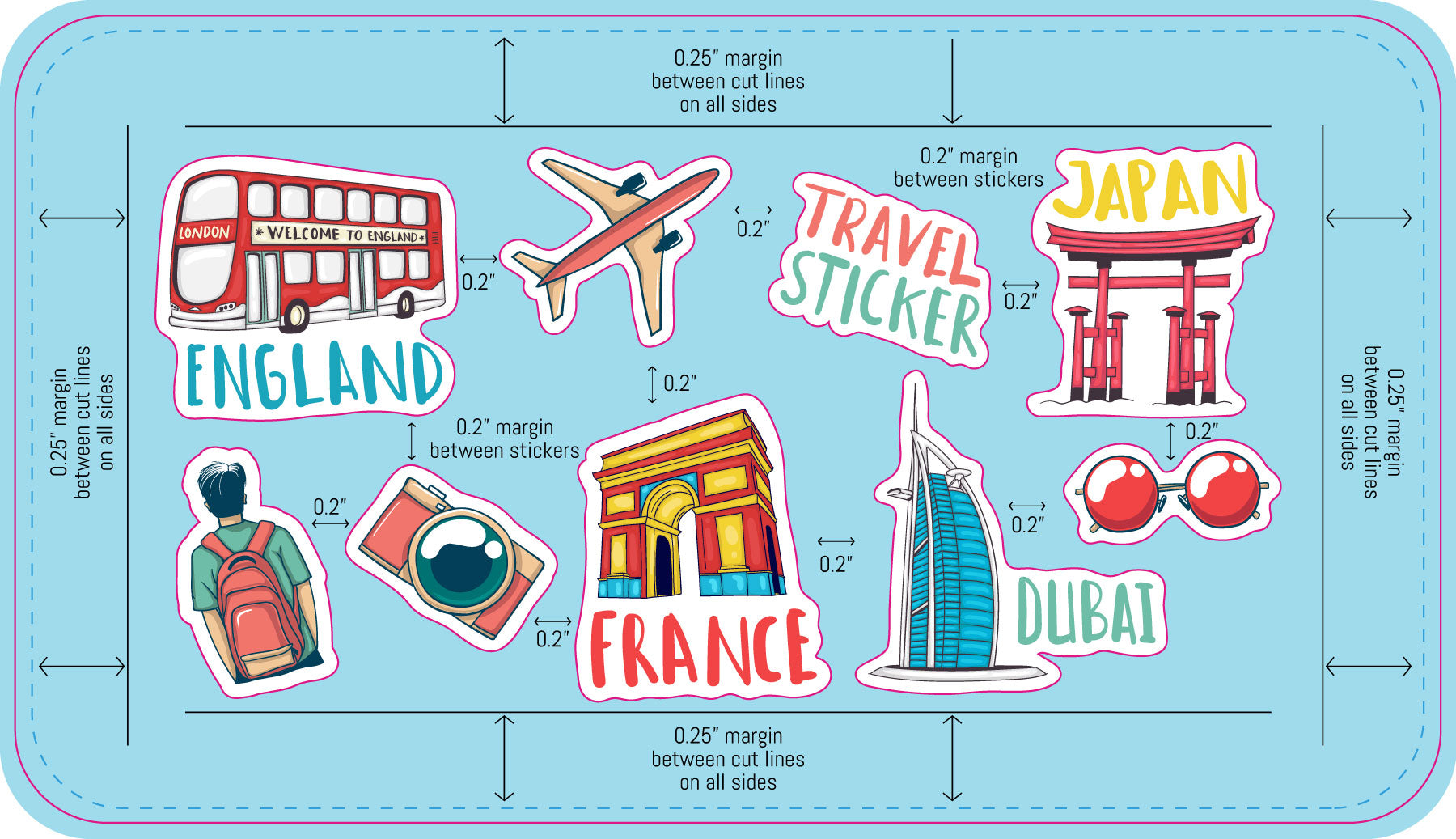
Setting Up Sticker Sheets
Multiple designs and sizes on a single sheet.
Sticker sheets let you print several different designs together on one backing sheet. Our sheet templates come pre-populated with placeholder artwork that you replace with your own files.
Common Mistakes to Avoid
The issues that most often send a file back for revision.
- No bleed on the background: Artwork that stops at the die line leaves white edges when the cut shifts. Extend it 0.075 inch past the finished edge, or 1/8 inch for large-format products.
- Text too close to the edge: Anything outside the safe area can be trimmed off. Pull text and logos at least 0.075 inch inside the die line, or 1/8 inch for large-format products.
- Low-resolution images: Artwork saved from a website prints soft and pixelated. Work from the original high-resolution file whenever possible.
- Live fonts not outlined: Fonts we don't have installed get substituted. Convert all type to outlines before exporting.
- RGB color mode: Vivid RGB colors can't always be matched in CMYK. Design in CMYK to see accurate colors from the start.
- Die line left in the artwork: The cut line is a guide, not a design element. Remove it or keep it on its own separate layer.
- Wrong template size: Make sure the template you downloaded matches the size you actually ordered.
From File to Finished Print
What happens after you place your order.